
Being arrested can be confusing and stressful, especially for someone who has never experienced the criminal justice system before. Many people immediately wonder what will happen next, whether they will be released, when they will see a judge, and whether they need a lawyer.
Understanding what happens after an arrest can make the legal process easier to follow. Although the exact procedure varies depending on the country, state, province, and type of alleged offense, many criminal justice systems follow a general sequence.
After an arrest, authorities may complete booking procedures, collect information, conduct certain searches, and begin the process of determining whether charges will be filed. The accused person may then have a court appearance where issues such as release, bail, or detention are considered.
This guide explains what happens after an arrest in simple language. It covers booking, questioning, bail, court appearances, criminal charges, evidence, prosecutors, defense lawyers, hearings, and possible outcomes.
Criminal procedures vary significantly by jurisdiction. This article is general educational information and is not legal advice for a specific criminal case.
What Happens After an Arrest?

The answer to what happens after an arrest depends on the circumstances and local law.
A general process may include:
- Taking the person into custody
- Booking and identification
- Recording personal information
- Photographing and fingerprinting where required
- Informing the accused about certain rights
- Questioning or investigation
- Initial court appearance
- Bail or detention decision
- Formal charging
- Further court proceedings
Not every case follows exactly the same order.
What Is an Arrest?
An arrest generally occurs when law enforcement takes a person into legal custody because they are suspected of committing an offense.
An arrest is not the same as a conviction.
A person can be arrested and later released without being convicted of any crime.
The legal requirements for making an arrest vary depending on the jurisdiction and circumstances.
What Happens During Booking?
One of the first steps in understanding what happens after an arrest is learning about booking.
Booking is an administrative process used to record information about a person who has been taken into custody.
Depending on local procedures, booking may include:
- Recording the person’s name
- Recording the alleged offense
- Taking fingerprints
- Taking photographs
- Recording physical information
- Checking existing records
- Collecting personal property
The person’s belongings may be inventoried and stored while they remain in custody.
Why Are Fingerprints Taken After an Arrest?
Authorities may take fingerprints to confirm a person’s identity and create or update official records.
Fingerprint requirements vary according to local law and the nature of the case.
Fingerprinting does not by itself prove that a person committed an offense.
Why Are Photographs Taken?
Authorities may take a photograph, sometimes called a booking photograph, as part of the identification and recordkeeping process.
Whether such photographs are publicly available depends on the jurisdiction and applicable rules.
What Happens to Personal Property?
During booking, authorities may collect personal belongings for safekeeping.
Items may include:
- Wallet
- Phone
- Keys
- Money
- Jewelry
- Other personal property
The procedure for returning property depends on the detention facility and circumstances of the case.
You may also like these posts:
Child Support Laws Explained: A Complete Guide
Marriage Legal Rights Guide: What Couples Should Know
Small Business Legal Rights: Complete Beginner’s Guide
Common Business Legal Issues: A Complete Guide
Are People Questioned After an Arrest?
A person may be questioned during a criminal investigation, including after an arrest.
However, the accused may have important legal rights concerning questioning.
The exact rights depend on the jurisdiction.
A person who is under investigation or facing criminal allegations should consider obtaining advice from a qualified criminal defense lawyer before answering detailed questions.
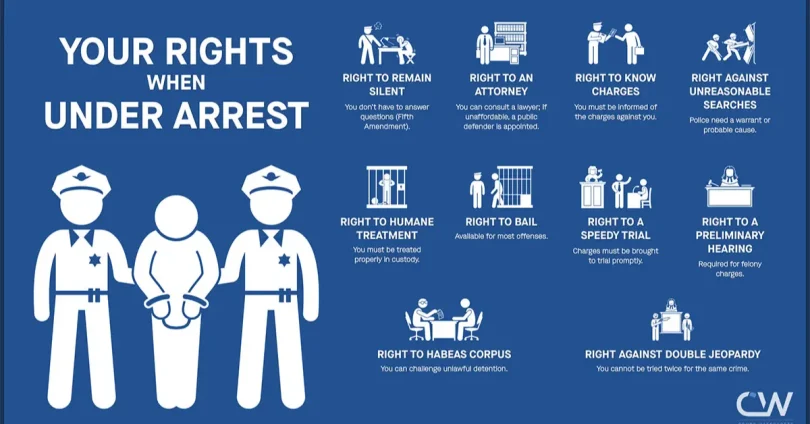
What Are Legal Rights After an Arrest?
Understanding what happens after an arrest also means understanding that arrested individuals generally have important legal protections.
Depending on the jurisdiction, these may include rights relating to:
- Legal representation
- Silence or protection against compelled self-incrimination
- Information about the allegations
- Court proceedings
- Bail or release
- Due process
The exact scope of these rights varies by legal system.
What Is the Right to Remain Silent?
In many legal systems, an accused person has protections concerning self-incrimination.
This may allow the person to decline to answer certain questions.
The exact rules and procedures vary by jurisdiction, so a person should seek local legal advice when facing an actual investigation.
What Is the Right to a Lawyer?

People accused of crimes may have a right to legal representation, particularly in serious criminal cases.
Depending on the jurisdiction, a person who cannot afford a lawyer may qualify for publicly funded legal assistance.
A defense lawyer can help explain:
- The allegations
- Legal rights
- Possible defenses
- Court procedures
- Bail conditions
- Potential consequences
What Happens at the First Court Appearance?
A first court appearance is an important part of what happens after an arrest.
Depending on the legal system, the court may:
- Confirm the person’s identity
- Explain the allegations
- Consider release or detention
- Address bail
- Schedule another hearing
- Consider legal representation
The exact procedure varies by jurisdiction.
What Is Bail?
Bail is a legal process that may allow an accused person to remain outside custody while the criminal case continues.
Bail may involve:
- Money
- A bond
- A promise to appear
- Supervision
- Specific conditions
Not every person is eligible for release on the same terms.
What Factors Can Affect Bail?
A court may consider factors such as:
- Seriousness of the alleged offense
- Risk of fleeing
- Criminal history
- Public safety
- Risk of interfering with witnesses
- Community connections
- Previous failures to appear
The factors and standards vary according to local law.
What Are Bail Conditions?
If a person is released, the court may impose conditions.
These can include:
- Attending future court hearings
- Avoiding certain people
- Staying within a particular area
- Reporting to authorities
- Following travel restrictions
- Avoiding certain activities
Breaking release conditions can lead to additional legal consequences.
What Happens If Bail Is Denied?
If release is denied, the accused person may remain in custody while the case continues.
A later hearing may allow the court to reconsider detention or release depending on the applicable legal process.
The rules vary between jurisdictions.
What Happens After Charges Are Filed?
Understanding what happens after an arrest requires distinguishing an arrest from a formal criminal charge.
A person may be arrested before formal charges are filed, depending on the legal system.
After an investigation, prosecutors or another authorized authority may decide whether criminal charges should be formally brought.
The process differs between jurisdictions.
What Is a Criminal Charge?
A criminal charge is a formal accusation that a person committed a particular offense.
A charge is not proof of guilt.
The prosecution generally must establish the accused person’s guilt according to the required legal standard before a conviction can occur.
Can Someone Be Released Without Charges?
In some situations, a person may be released without criminal charges being filed.
This can happen when authorities determine that there is insufficient evidence or when other legal circumstances apply.
However, release does not necessarily mean that an investigation can never continue.
What Is a Prosecutor?
A prosecutor is a government legal representative responsible for bringing or presenting criminal cases.
Depending on the jurisdiction, prosecutors may have different titles and responsibilities.
The prosecutor generally reviews evidence and determines whether charges should be pursued according to applicable law and procedures.
What Does a Defense Lawyer Do After an Arrest?
A defense lawyer can play an important role in explaining what happens after an arrest.
A lawyer may:
- Explain the charges
- Advise the accused about legal rights
- Review evidence
- Communicate with prosecutors
- Represent the accused at hearings
- Challenge unlawful procedures
- Discuss possible defenses
- Negotiate where legally appropriate
The exact role depends on the case and jurisdiction.
What Happens During a Preliminary Hearing?
Some legal systems use preliminary hearings or similar proceedings.
A preliminary hearing may address whether there is sufficient evidence to continue a criminal case.
The procedure varies considerably.
Not every criminal case includes a preliminary hearing.
What Is an Arraignment?
An arraignment is a formal court proceeding recognized in some legal systems.
It may involve:
- Reading or explaining charges
- Asking for a plea
- Discussing legal representation
- Addressing bail or release
- Scheduling future proceedings
The term and procedure are not used in exactly the same way everywhere.
What Is a Plea?
A plea is the accused person’s formal response to a criminal charge.
Depending on the jurisdiction, a person may plead:
- Guilty
- Not guilty
- No contest or an equivalent plea where recognized
The legal consequences differ depending on the plea.
What Happens If the Person Pleads Guilty?
If a person pleads guilty, the case may proceed toward sentencing without a full trial.
Before entering a guilty plea, an accused person should understand the potential legal consequences.
A qualified defense lawyer can explain the applicable procedure and possible outcomes.
What Happens If the Person Pleads Not Guilty?
If the accused pleads not guilty, the case generally continues.
Further proceedings may include:
- Evidence disclosure
- Pretrial hearings
- Motions
- Negotiations
- Witness preparation
- Trial
The exact process depends on the jurisdiction.
What Happens During the Investigation?
Even after an arrest, authorities may continue investigating the alleged offense.
Investigators may collect:
- Documents
- Digital records
- Photographs
- Video
- Physical evidence
- Witness statements
- Forensic evidence
The prosecution may later rely on admissible evidence gathered during the investigation.
What Is Evidence?
Evidence is information used to establish or challenge facts in a criminal case.
Evidence can include:
- Witness testimony
- Documents
- Photographs
- Videos
- Physical objects
- Digital information
- Forensic evidence
- Financial records
Rules determine whether particular evidence can be used in court.
Can Evidence Be Challenged?
Yes. Depending on the circumstances, a defense lawyer may challenge evidence.
For example, a lawyer may argue that evidence was:
- Obtained unlawfully
- Unreliable
- Irrelevant
- Improperly handled
- Inadmissible under applicable rules
The court decides evidentiary issues according to the applicable law.
What Happens Before Trial?
Before trial, the parties may participate in several legal proceedings.
These can include:
- Pretrial hearings
- Evidence disclosure
- Motions
- Plea negotiations
- Scheduling hearings
- Legal arguments
The purpose is generally to prepare the case for trial or another resolution.
Can a Criminal Case End Without a Trial?
Yes. Not every criminal case reaches a full trial.
A case may end through:
- Dismissal
- Guilty plea
- Plea agreement
- Diversion or another alternative process where available
- Other legal resolutions
The available options depend on the offense and applicable law.
What Happens If the Case Goes to Trial?
If the case goes to trial, the prosecution and defense present evidence and legal arguments according to court procedures.
A trial may involve:
- Jury selection where applicable
- Opening statements
- Witness testimony
- Cross-examination
- Physical or documentary evidence
- Closing arguments
- Decision by a judge or jury
The exact procedure varies by jurisdiction.
Who Has to Prove Guilt?
In many criminal justice systems, the prosecution has the burden of proving guilt beyond a reasonable doubt.
The accused person is generally presumed innocent unless guilt is established according to the applicable legal standard.
This is a fundamental concept when learning what happens after an arrest.
What Happens If the Person Is Found Not Guilty?
If the accused is found not guilty, the criminal charge may end with respect to that proceeding, subject to applicable law and any unusual circumstances.
The person is not criminally convicted of the charge.
What Happens If the Person Is Found Guilty?
If the person is found guilty, the case generally proceeds to sentencing.
Depending on the offense and jurisdiction, penalties can include:
- Fines
- Probation
- Community service
- Restitution
- Restrictions
- Imprisonment
The specific sentence depends on applicable law and the facts of the case.
What Is Sentencing?
Sentencing is the stage at which the court determines the legal consequences following a conviction or guilty plea.
A judge may consider factors such as:
- Seriousness of the offense
- Criminal history
- Harm caused
- Applicable sentencing rules
- Aggravating factors
- Mitigating factors
The exact rules vary by jurisdiction.
Can an Arrest Affect Employment?
An arrest can sometimes create practical consequences for employment, but an arrest is not the same as a conviction.
Whether an employer can take action based on an arrest depends on applicable employment and privacy laws.
The legal rules can vary considerably.
Does an Arrest Mean Someone Is Guilty?
No.
An arrest means that a person has been taken into custody according to legal authority. It does not establish guilt.
A person may later be released, have charges dismissed, or be found not guilty.
How Long Can Someone Be Held After an Arrest?
The amount of time a person can be held depends on the jurisdiction, the alleged offense, and the applicable legal procedures.
Many legal systems require authorities to bring an arrested person before a court within a specified period.
The exact time limits vary.
What Should Someone Do After an Arrest?
A person facing an actual arrest or criminal investigation should focus on protecting their legal rights.
Generally useful steps may include:
- Remain calm
- Follow lawful instructions
- Avoid physically resisting arrest
- Understand applicable rights
- Avoid making unnecessary statements about the alleged offense
- Request legal assistance where appropriate
- Keep track of court dates and documents
Because procedures differ, local legal advice is important.
Common Mistakes After an Arrest
Understanding what happens after an arrest also means knowing what mistakes to avoid.
Ignoring Court Documents
Missing a court date or legal deadline can create additional problems.
Assuming the Case Is Over After Release
Being released does not necessarily mean the criminal matter has ended.
Discussing the Case Online
Social media posts, messages, or public statements can potentially become relevant to a legal case.
Destroying Evidence
Deleting messages, documents, or other information can create serious legal problems.
Assuming an Arrest Means Conviction
An arrest is only one stage of a criminal process and does not establish guilt.
How Can a Criminal Defense Lawyer Help?
A qualified defense lawyer can help a person understand what happens after an arrest based on the specific jurisdiction and circumstances.
A lawyer may explain:
- The alleged offense
- Legal rights
- Bail options
- Court procedures
- Evidence
- Possible defenses
- Potential penalties
- Available legal strategies
Anyone facing serious criminal allegations should consider obtaining professional legal advice.
What Happens After an Arrest: A Simple Timeline
A general criminal process may look like this:
Arrest
Authorities take the person into custody.
Booking
Authorities record identifying and administrative information.
Release or Detention Decision
The person may be released, released with conditions, or kept in custody depending on applicable law.
Charges
Criminal charges may be formally filed.
Initial Court Appearance
The accused appears before a court.
Pretrial Proceedings
The parties address evidence, motions, negotiations, and other legal matters.
Trial or Other Resolution
The case may go to trial or end through another legally permitted process.
Sentencing
If there is a conviction, the court may impose a sentence.
Appeal
An appeal may be available in certain circumstances and subject to strict deadlines.
Frequently Asked Questions
What happens immediately after an arrest?
After an arrest, authorities may take the person through booking, identification, property inventory, and other custody procedures. The person may later appear before a court or be considered for release according to local law.
Does an arrest mean you are guilty?
No. An arrest is not a conviction. A person accused of a crime generally remains presumed innocent unless guilt is established through the applicable legal process.
What happens after an arrest if there are no charges?
Depending on the circumstances, the person may be released without charges. An investigation may or may not continue depending on applicable law and available evidence.
Can you get bail after an arrest?
In many legal systems, an arrested person may be considered for release on bail or other conditions. Eligibility and conditions depend on the jurisdiction and circumstances.
How long can someone stay in custody after an arrest?
The permitted period varies by jurisdiction and circumstances. Many legal systems require an arrested person to be brought before a court within a specified period.
Conclusion
Understanding what happens after an arrest can make the criminal justice process easier to understand. An arrest is usually only the beginning of a longer legal process and does not mean that the person has been found guilty.
After an arrest, authorities may complete booking procedures, investigate the alleged offense, and begin the process of determining whether formal charges will be pursued. The accused may then appear in court, where release, bail, detention, charges, and future proceedings may be considered.
A criminal case can eventually end through dismissal, a guilty or other plea, an agreement where legally permitted, a trial, or another legal process. If there is a conviction, the court may impose a sentence according to applicable law.
It is important to remember that criminal procedures vary significantly between jurisdictions. The rights, deadlines, bail rules, charging procedures, and court processes in one location may be different from those in another.
Anyone who has actually been arrested or is under criminal investigation should consider speaking with a qualified lawyer in the relevant jurisdiction. Professional legal advice can help the person understand their specific rights and available options.